WELCOME!

Welcome to my little blog of sermons and stories. I don't consider myself a "preacher." When I'm preached to, I fall asleep. zzzzzzzzzz. So do you! But if I hear a good story, I listen and chew on it until it sinks in. Kids tune out at lectures but they love stories...and we're all kids at heart.

So, set aside sin and guilt and all that institutional claptrap and sit back and revel in the love of God which has no strings attached. And always remember to laugh.

And for my sister and brother story tellers out there, remember plagiarism is the highest form of flattery. ;)

Wednesday, May 4, 2011

CREDO IN UNUM DEUM

I received a nice email yesterday from a reader who asked what I believed. This wasn't a test of my orthodoxy. I'm an Anglican and for us "orthodoxy" covers a broad spectrum. Personally, I tend to fall on the more Catholic side of that spectrum, all with a sense of humor and knowing that what I know is at best only very slight and partial.

So, I replied with this Affirmation of Faith from my book, New Daily Prayer, www.newdailyprayer.net ( which you have to cut and paste into your address thingy above since the Link tab on this contraption doesn't seem to work) in case you'd like a copy but I'm not really here to be hawking books! The next reprint is in progress.) The text of this Affirmation is below.

I might add that while I am a follower of Jesus of Nazareth, whom we call the Christ or the Messiah, and affirm him as the full Incarnation of God (whatever that really means) I have no doubt that God has been present in the other great prophets and sages through out history with the exception of Joseph Smith who really wasn't either. I also buy into the doctrine of the Trinity as the best we humans can do to explain that which is unexplainable. Ultimately, God knows who He/She/It is which, I guess, is the most important part of it all.

In any event, here goes:


We believe in One God as revealed in the Scriptures
and the ancient Tradition
of the Catholic and Apostolic Church:
the Source of All, the Word made Flesh and Giver of Life;
the Wellspring of all life and mystery
who created and creates all things great and small
n the beauty of holiness.
We believe in Jesus Christ, God With Us,
who was born of Mary, lived, and was raised from the dead;
who reveals God’s heart of peace and forgiveness,
tenderness and compassion, power and might,
which is stronger than even death itself;
We believe in the Spirit who floods us with courage,
and empowers us to be God’s presence in the world.
We believe in our calling to respond to others
as God responds to all:
with mercy, hope, and Grace,
n trust and openness, wonder and joy, peace and simplicity
and in solidarity with the poor,
the marginalized and the outcast.
We rejoice in the new life which bread and wine,
water and oil communicate to us,
and that through them and in us, Jesus is truly present.
We participate in and await the fulfillment of God’s dominion,
in which all find their final rest in union with
the Source of All, the Word made Flesh,
and the Giver of Life,
who lives and reigns, one God, for ever and ever.
Amen.


Rublev's Trinity

Monday, May 2, 2011

THOMAS DOUBTED. WOULDN'T YOU??? EASTER II

I’ve always thought Thomas got a bad rap. I don’t blame him for doubting. Wouldn’t you???


By this time in the lives of those of us who are “mature,” we’ve all lost someone dear to us. I lost a spouse almost twenty-five years ago – it’s ancient history so don’t go getting all condolency on me. We’ve all had equally significant tragedies. But, if a week after Jeffrey had died, someone came up to me and said, “Hey! We saw him walking around and talking to people,” I’d’ve replied, “That’s not funny! It’s CRUEL! AND we’re no longer friends! Have a nice life!!” It’s a cruel prank and not one that a “friend” perpetrates. And it was the take that Thomas put on the Apostles telling him that they’d seen Jesus. He wasn’t amused. He was broken hearted and these “friends” of his were pulling a cruel joke. And it wasn’t funny.

Of course, this all took place in the Upper Room where the Last Supper had been held. The week before, the guys had been all holed up there in fear of the Jews… not ALL of the Jewish nation, but the Temple Authorities and the priests, as well as the Romans. They were scared out of their minds that they’d suffer the same fate as their Rabbi. Add to that, Jesus kept appearing to them which didn’t help any. These are the guys who’d scattered in his hour of need and even denied him. The women hadn’t. They seem to have understood the Resurrection. But these guys were so terrified and guilt-ridden that they couldn’t comprehend what was going on.

In the midst of all this fear and angst, appears the Risen One. And it’s a tender but tense moment. Into the midst of their multi-emotional mess, the Risen One comes and says to them, “Peace be with you.” Not, “Where the $$$$ were YOU!?” He greets them with tender love and bids them peace. And at that moment, they get it. They understand what’s going on. Here, in the middle of their fear and guilt, there is no condemnation, no judgment, no bitterness, just love. They now begin to comprehend what the past three years had all been about, what the crucifixion had all been about, what the Resurrection was all about. They know that they are not condemned but loved, unconditionally, and that the source of that love is the Source of All Things standing in front of them as the Risen One.


But Thomas wasn’t there and he couldn’t buy it because he hadn’t yet experienced it. So, the Risen One comes again the following week and bids them all, including Thomas, peace. And Thomas is blown away. And it’s these guys and the women who find their lives totally transformed, so much so that they and their descendants go on to change the course of human history.

But back to doubt. I don’t blame Thomas. He had a right to doubt. And, ultimately, doubt is a good thing, maybe even a grace. Each time we doubt, we go on an adventure, a scavenger hunt for the truth, for certainty to answer our doubt. And when we find it, we rejoice and it feels great. Then, in time, we begin to doubt the new truth, so we go searching again, but this time we find even deeper truth. And in time, we doubt that deeper truth and we go searching again and the cycle goes on and even deeper. And in the process, we find even more refined and clearer truth and that truth brings us deeper into the mystery of God, of the Risen One, of the truth of the fact that we’ve never been condemned, only loved with a tender love which one has for the beloved, the love we continue to have for those we’ve lost and for those who are still with us.

So, go ahead and doubt. And, doubt boldly that grace may abound! (Forgive me, St. Paul!) Doubt with clarity and fortitude and go on the search. And you will find the truth: the truth made known to us in Jesus Christ, our Risen Lord.

Amen.


ALLELUIA! CHRIST IS RISEN!!!
CHRIST IS RISEN INDEED!! ALLELUIA!!!!

REST IN PIECES, OSAMA


OK, Osama’s dead. Yeah! Hooray! and all that stuff. He wasn’t a nice guy. And he was about a good of a Muslim as Pat Robertson is a Christian. They’re both terrorists. Hopefully they’ll meet soon. And while old Osama’s getting acquainted with Attila, Genghis and Adolf, don’t forget that God’s love is stronger than their evil and that eventually they’ll be reconciled with the Almighty. It may take a gazillion years, but that’s the way God seems to work.

Osama was a bad man, to put it overly mildly. At the same time, while he probably meant something different, his words were correct: “America is a decedent society.” If we look at where we are and what we’ve been doing for the last thirty years, it’s no wonder that we’re in the state we’re in. We’ve become a nation of narcissists for whom “it’s all about ME! I want it now! I want something better than you have! I deserve it because I’m ME!” Multiply that by 300 million and you have chaos.

But the Gospel isn’t about ME! It’s about US! (and I don’t mean the U. S.!) Jesus’ message is that we are all sisters and brothers bound together by the fact that we live on this planet and that our job is to look out for each other. And when we make decisions, we’re supposed to make those decisions based not only on how they will benefit “me,” but what the consequences will be on us as a whole. Unfortunately, we’ve forgotten all of that. Even American Christianity by and large has bought into the “me” thing. It’s all about me and my Jesus and my salvation. Yet, in the Early Church, “salvation” was a communal thing. One was “saved” by being part of the Christian community, being baptized into it and eating at the common table.

And the other Sages were all about the same thing: Buddha, Mohammad, Moses and Abraham, the writer of the Tao te Ching, Kung Fu Zu aka Confucius, etc.. Jesus is unique in many ways, but on this topic, he's one of many.

I had tea with my friend Mother Rebecca this afternoon and we talked about the fact that Osama may have killed 3,000 people on 9/11, but in the ensuing years, the previous administration then murdered over a million people - people who got the blame but had absolutely nothing to do with 9/11 - just so they could reap billions personally for the sake of almighty oil. It makes one wonder who the real terrorists are. Are they in a far away land with rags on their heads or are they in our own back yards?


I was, for the first time in a long time, impressed by President Barry last night. His words weren’t about “me” but about “us.” So, I hope he takes his own words to heart. I hope and pray that he is able to show the same leadership in standing up to the Republicans and their plan to dismantle the American republic in favor of the rich at the expense of the rest of us. The Republicans are all about “me!” because “I” deserve it. But they don’t; not any more than the rest of us do.

So, Barry, keep that spine you just grew moving. Keep on talking about “us” and confront the “me’s.” Whether you know it or not, last night you stood on the side of Christ...and the rest of those folks. My prayers are with you.

Blessed Mother of God, pray for us. We need all the help we can get!

Friday, April 22, 2011

REQUIEM FOR A DREAM - Good Friday


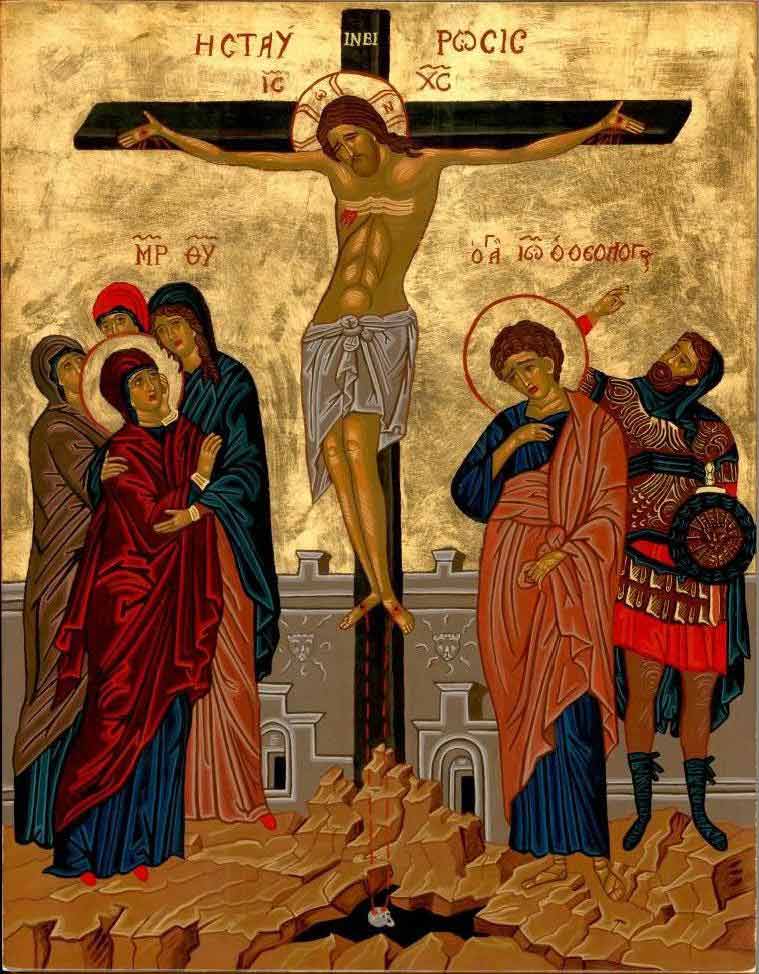
A death has occurred. Oh, yes; Jesus is dead. We know this. We’ve based our religion on it. But there has been another death. Christ has been crucified once again. This time in 2011. And we’re still in the denial stage.

This death was not execution. It was from disease. The illness started at the turn of the millennium and the symptoms proceeded to worsen. In Wisconsin and the tumor blew open and ended when budget debate was over. Death came quietly. The breathing and the heart just stopped. It was over.

In watching the debates over the budget as well as all that has transpired in this new millennium, it has become apparent that the body has now been buried. Like the first disciples, few if any of us want to admit that it’s really happened. America as we know it is dead. The ideals of liberty, justice and healthy capitalism have died. The America we grew up in, the America our fathers fought for and our mothers did without for in fighting Fascism in the 40s has become what they had been fighting.

Americans are still allowed to vote, but for what? No matter whom we elect, we get the same thing: politicians whose pockets are lined with the cash of big business, politicians whose motives are to bolster the rich so they themselves can become richer. No matter how we vote or for what we vote, the result is always the same: protect the wealthy, protect big business who continues to give itself outrageous bonuses, bonuses from the money the American tax payer gave, free of charge, for their, big business’s greed and subsequent all expenses paid trip to the abyss of economic ruin. In some ways, this message is not new. (The Temple Authorities and the Romans were just the same.) But it’s what caused the tumor.

To that, we can add the eight years before during which time the surplus which had been accrued in the previous decade was squandered on a war which no one needed except those who wanted to line their pockets with that surplus. And in the process, countless billions were wasted on war and war profiteering all paid for by the American tax payer.

Now we, the American tax payer, are being told that it is our responsibility, our obligation, to pay for all the bills which have been racked up by war, profiteering, corporate greed and deplorable economic behavior. This is to be paid by laying it on the backs of the poor, the marginalized and the elderly, the last being the ones who scrimped and saved and made American what it had been.

The America which the Founders envisioned is dead. And only one Person came back from the dead. And I’m afraid that America isn’t he. There will be no resurrection.

The new America has shades of the fascism our parent’s generation tried to destroy. National Socialism was all about supporting big business at the expense of the people. It was also a totalitarian state which “discouraged” any and all noncompliance. Its intolerance and repression are notorious. And now it has come to our own shores masquerading as patriotism, piety and liberty.

The future looks as bleak now in America as it did in Germany in 1933, for Jesus in 29 AD. The Koch brothers – the I. G. Farben and Krupps Korporation of their time - those in our political leadership, and those like them want one thing: a passive American work force which will gladly work for $2.00 an hour with no benefits, pension or health care. In the process, corporate interests will continue to rack up trillions of dollars - through the labor of the American people - to keep them in the lap of luxury. Our military has now and will only have one objective: the protection of corporate interests and wealth – such as the oil fields in Libya and the destruction of any system which is perceived as a threat. We will live in houses we rent from the corporations and shop at corporate stores.

Already our liberties are in question. Freedom of religion is on the way out. Look at the xenophobia concerning Islam and the tight relationship between corporate and political leaders with “Christian” fundamentalists. Freedom of the press has been dead for a long time. It’s become “freedom of entertainment.” With few exceptions, the media is just an arm of those with power to keep the American people confused and frightened. It is the modern equivalent to Caesar’s “bread and circuses.” The judicial system is now based on winning cases, not on uncovering the truth or facts. Our other liberties and freedoms will be the next to go – all in the name of national security, patriotism and God.

In the process, an American’s life expectancy will plummet due to the unaffordability of heath care. Our elderly will go without medical treatment for lack of funds to purchase coverage. Most of them will die abandoned in substandard housing with no one to look after their needs.

Already there is talk of dismantling public education because government sponsored or supported anything is labeled as “socialism.” Only the wealthy will be able to afford an education. The closing of the public schools will enable those in power to raise up generations with only basic, rudimentary skills: people who will have no knowledge of our national or world history and the inevitability of its repeating itself. Intellectualism will be seen as a threat to those in power and scoffed at as old fashioned and outdated. The general populace, uneducated and ignorant, will certainly be much more pliable to meeting the ever-growing “needs” of those in power.

Fundamentalism will be portrayed as the only true interpretation of Christianity. Roman Catholic and Protestant fundamentalists will indoctrinate the American people with the fallacy that such an interpretation is the true word of God, never to be questioned. With the subtle rise of anti-Semitism in recent years, who knows what will happen to the Jews.

The ultimately sad part is that there is nothing which we, the American people, can do about any of this. Short of armed insurrection, which I am absolutely not advocating – I’m a strict pacifist – the only thing we can do is mourn the death, gird our loins and prepare for the worst. It’s coming. Even if we did take up arms in mass insurrection, those with the financial resources can out-arm the American people to the ultimate degree. It would be like the Destruction of Jerusalem in 70 AD.

On a theological level, there is always hope. God is alive and well and always on the side of the oppressed, the marginalized, the outcast and the poor. The Hebrew Scriptures attest to the fact that when the rich got richer and fewer and the poor got poorer and poorer and grew to multitudes, God stepped in and yelled, “OK! Everybody outa d’pool! The party’s over. The Syrians/Romans/Babylonians/Whoever are coming in and carting off the rich into slavery. Those of you left behind can start all over again.

I still believe in that hope. The problem is that things have changed drastically in the last three thousand years. Like with the ancient Hebrews, the only way in which things can change and get better will have to be after a relatively long period of time. The truth is that what the corporations and the politicians are working towards and will succeed in getting isn’t sustainable. It’s a house of cards and eventually a slight breeze will come along and knock it all down. What’s left of America will have to pick up the pieces and it may take hundreds of years before the light is anything more than a glimmer at the end of the tunnel. Certainly, this nation will never again be what it was except, like the Roman Empire, a subject in a history book. America may have to crumble as did the Soviet Union into several different nations. But, who really knows the outcome?

In the process, we as Christians have the obligation to live and move into the future – a future of which, like that of the disciples, the details are absolutely uncertain. How will we live and give witness to the message of Jesus against oppression and injustice? How will we stand with the marginalized and the forgotten? How will we care for the needs of those who’ve been left out in the storm to die? How will we live out compassion, love, mercy and forgiveness in a society which sees such things as the hysterical rantings of lunatics? How will we overcome our own fear and cynicism? How will we join with those who vision God in different ways and worship God using a different name but who understand through their own prophets and sages what Jesus taught us and for which he died? And how will we feed our own souls so that when the house of cards does fall we can be witnesses of hope?

I have no answers to these questions. I am no prophet nor sage. I’m not even sure I have the courage to meet the future as I perceive it. At the same time, I do believe that we need to begin the process of addressing who and what we will be as a people of faith as the present moves into an uncertain future with the possibility of chaos and tyranny.

I truly believe that Franklin Roosevelt was right: the only thing we have to fear is fear itself. The real question may well be: how do we move into the future with goal of overcoming that fear? The only answer I can think of is that we need to begin now, not just as individuals but as community, to begin to name the fears we perceive in the present and for the future. Naming the fear is the beginning of overcoming and disarming it. Naming the fear begins to let the air out of its tires. Naming the fear is the beginning of resurrection.

To confront the fear, we also need to pray. I’m not talking about Polly Anna prayer or the kind of stuff one reads in Helen Steiner Rice cards leading to diabetic coma. I’m talking about being silent and in awe before the Ultimate Power of the Universe, whom Christians believe became human in Jesus of Nazareth, and being connected with that Being in a place deep within ourselves. For many of us, this will be a new endeavor – this is not a criticism; the Church has failed us in this endeavor. For many of us, we will have to look to the more saintly around us for guidance and instruction.

For us Christians, we will need to celebrate the Sacraments with purity of heart. The Christian Liturgy is intended to lead us more deeply into the Divine Presence via ritual and ceremony which alone can express the unspeakable depths and longings of the human heart. We will need clergy and layfolk alike whose art and craft can make that moment where time and space dissolve and unity, if even partial, with the Divine is as real as the air we breathe.

We will need to “read, mark and inwardly digest” the Scriptures and the Sacred Tradition of the Church so that we know what they really say instead of the pabulum we have been fed for centuries. We will need scholars and teachers, philosophers and coaches to feed our minds as the clergy are called to feed our souls. And we will need open, nonjudgmental ears to hear the depths of our souls as we try to sort out, individually and collectively, the emotions and thoughts which will bubble up inside us.

The most difficult thing for us as Christians, though for the life of me I can’t understand why, will be to overcome our suspicion and fear of those who vision God in a manner different than our own. We will need to – because it’s reality! – see those of the other great Faiths as sisters and brothers whose experience of the Divine is just as valid and real as our own. We will need to gather and pray together – both corporately as well as in ways faithful to our own Traditions - in sincerity and truth. We will all together need to understand and affirm that our perceptions of the Divine can only ever be partial because we are limited in our humanity and that those of another Faith may have a more profound insight into God than we do and us for them. And we must be prepared to offer the profundity of our own Tradition. We will need to listen and hear with new ears to the witness of “the other” without trying to convert the other to our way of belief. For us as Americans this means that Jews, Christians and Muslims will need to affirm those things that unite them and deal with the things over which they have differing opinions at another time – if they’re still important then. And it means that we of the Abrahamic Faiths will need to offer the same openness to the rest of the Faithful. We may even need to be open to the witness of those who inhabited this continent for thousands of years before the Europeans showed up. Their witness is an invaluable part of Faith tradition.

OK, so maybe there is the possibility of resurrection; not just Jesus rising from the tomb almost two thousand years ago but also our own – rooted deeply in his. But we probably won’t see it in our own time. But we can plant the seeds. The time of planting is now. Where do we go from here?

The choice is ours.

Monday, February 14, 2011

THE 6TH SUNDAY AFTER EPIPHANY - 13 February 2011

Preached at St. Clement’s Church, Seattle

The Gospel: Matthew 5:21-37
Jesus said, "You have heard that it was said to those of ancient times, `You shall not murder'; and `whoever murders shall be liable to judgment.' But I say to you that if you are angry with a brother or sister, you will be liable to judgment; and if you insult a brother or sister, you will be liable to the council; and if you say, `You fool,' you will be liable to the hell of fire. So when you are offering your gift at the altar, if you remember that your brother or sister has something against you, leave your gift there before the altar and go; first be reconciled to your brother or sister, and then come and offer your gift. Come to terms quickly with your accuser while you are on the way to court with him, or your accuser may hand you over to the judge, and the judge to the guard, and you will be thrown into prison. Truly I tell you, you will never get out until you have paid the last penny. "You have heard that it was said, `You shall not commit adultery.' But I say to you that everyone who looks at a woman with lust has already committed adultery with her in his heart. If your right eye causes you to sin, tear it out and throw it away; it is better for you to lose one of your members than for your whole body to be thrown into hell. And if your right hand causes you to sin, cut it off and throw it away; it is better for you to lose one of your members than for your whole body to go into hell. "It was also said, `Whoever divorces his wife, let him give her a certificate of divorce.' But I say to you that anyone who divorces his wife, except on the ground of unchastity, causes her to commit adultery; and whoever marries a divorced woman commits adultery. "Again, you have heard that it was said to those of ancient times, `You shall not swear falsely, but carry out the vows you have made to the Lord.' But I say to you, Do not swear at all, either by heaven, for it is the throne of God, or by the earth, for it is his footstool, or by Jerusalem, for it is the city of the great King. And do not swear by your head, for you cannot make one hair white or black. Let your word be `Yes, Yes' or `No, No'; anything more than this comes from the evil one.


Well, isn’t THAT a cheery little Gospel?! I read this early in the week and thought, “Oh, gee, thanks. I REALLY wanna preach on THAT!” Of course, I was reading the lesson online while on another window I was watching Al Jazeera English and had CNN on the TV. I’ve spent any free time this week glued to the television watching the story unfold in Egypt. I’ve found it fascinating, at times quite moving and at others just downright profound.


As I’ve watched the demonstrators in Liberation Square being interviewed I realized that, if one doesn’t know what’s going on, one could think these people are stark raving loonie. They scream and they yell and they sound hysterical. But then I had to remember that people in the Middle East talk that way. They speak in hyperbole which is rich, flowery, sometimes intense language used to say what we say in brief, direct language. They think we’re rude. We think they’re nuts.

I remember back twenty-odd years ago when the First Gulf War began. When war had been decided upon, Saddam Hussein screamed, “This will be the Mother of all Wars!!! We will defeat the Great Satan and drive him into the sea!!! We will be victorious!!!” Now, Saddam was many thins, including nuts, but he wasn’t stupid. He knew very well that his military couldn’t defeat the United States. And had we been willing to do so, we could’ve chosen to understand what he was really saying using Middle Eastern hyperbole: “You’re going to attack us. We’re going to defend ourselves. And it’s not gonna be pretty.” Instead, we chose to ignore Saddam’s presentation and attacked with both barrels - taking him quite literally.

I’m married to a Jewish person who long before we met had converted to the Episcopal Church. But when we first got together, I thought his family was insane. All they did was scream at each other. I thought they all hated each other. Turns out, they’re a very loving family. My spouse bought me a book on how to translate Jewish. It helped a lot so that when my mother-in-law screamed, “Oy! It’s d’ end of d’voild! Nobody’s suffahed like I’ve suffahed!” I knew she actually just wasn’t feeling well that day.

And Jesus was a Jew. And he spoke in hyperbole just like Jews have for millennia. And his audience knew that but we sometimes forget. So, in this morning’s Gospel, Jesus sounds rather intense and off the wall, but he had no expectation, nor did his audience, that they would all go home, gouge out their eyes and cut off their hands. He also knew that just looking lustfully at a woman who wasn’t one’s wife wasn’t really adultery. But he was trying to make a point.

And Jesus also was pretty clear about the consequences. HELL! FIRE! DAMNATION!!! Well maybe.

Actually, the historical Jesus had no concept of hell. Neither did he seem all that concerned with the afterlife. It seems to be a given that eventually all would be reunited with the Divine. And when he speaks about the Kingdom of Heaven, he’s not talking about the next life. He’s talking about this life.


Hell wasn’t a concept for Jews of Jesus time nor does present day Judaism. Actually, the ancient Hebrews had no sense of afterlife at all. When you were dead, you were dead. Case closed. Let’s move on. It’s not until after the giving of the Torah at Mt. Sinai and Hebrew religion morphs into Judaism that the idea of Sheol starts to take form. Everybody went there: the good, the bad and the ugly. It was a place of shadows. There wasn’t any suffering but it wasn’t much fun either. It was like living in a low ceilinged cave with bad lighting or like being stuck in Tacoma in November.


Some substantial time before Jesus, the Pharisees came on the scene. They believed in Sheol but also that at the Last Day God would raise the righteous from the dead and the rest would just go into oblivion. By the time of Jesus, all three concepts were popular as well as a lot of mixing of all three. There was no central doctrine at all nor was it a great topic of conversation. Neither was there a sense of hell in the Church until the Third Century when the Church started to get too big to manage and the Bishops had to find some form of crowd control. But it wasn’t until St. Jerome came along in the Fourth Century and translated the Bible from Greek, Hebrew and Aramaic into Latin that things got firmed up. Jerome, a political animal as much as a scholar, chose to use the word “inferno” to translate the Aramaic word “Gehenna.” And Gehenna wasn’t hell. Gehenna was Jerusalem’s version of Waste Management. We don’t often think about it, but people in every time and culture have had to figure out how to get rid of their garbage. Jerusalem was no exception. Gehenna was outside the city walls and consisted of huge fires which burned 24 hours a day, seven days a week, 52 weeks a year for years and years and years. So, when one went into town, one put their garbage into their little, white plastic grocery bag and while out and about stopped by Gehenna, gave the bag to the attendant who then put it on a cart. Eventually, the cart was tossed on one of the fires and that was that.

Using hyperbole, Jesus in this morning’s Gospel is very definite and firm about one thing: human relationships. He’s saying that we are to treat each other with respect, compassion, mercy, advocacy and forgiveness. That’s the way it’s supposed to be. There are no exceptions. And he uses the only way he knew how to get the point across. And his audience knew what he was talking about. He wasn’t telling them that they’d burn for eternity because of an angry, petty deity. He was telling them that living a life of abusing others cuts one’s self off from God. God isn’t cut off from us. God is always there. But if we choose to live abusive and coercive lives, we distort our relationship with God and to the real meaning of life. And such a relationship is just as painful as sitting in the middle of the fires of Gehenna.

This seemingly hideous Gospel reading is actually a diatribe about hope because the reason Jesus insists that our relationships be honest and compassionate is because that’s how God is with us. One could use hyperbole and say, “God’s compassion and love for the human race is so great that no one could ever imagine it. It’s beyond any human comprehension! If one sat and thought about God’s eternal mercy for all time, one couldn’t begin to comprehend it!” OK. Maybe it’s not hyperbole. Maybe, just maybe, it’s the truth!


As I watched Al Jazeera this week, I was moved on Sunday when the Copts showed up. The Copts are the ancient Egyptian Christians who’ve been there since around the Sixth Century and make up about ten percent of the Egyptian population. They’re Eastern Orthodox of sorts and, while one can recognize the same basic structure of the liturgy as our Mass, it’s really weird! All sorts of strange customs and the like which seem very odd to us. On Sunday, several priests showed up with an Altar and all the paraphernalia to celebrate the Eucharist for the Copts in Liberation Square. And as the liturgy got underway, they were surrounded by a huge mob of Muslims. But these Muslims weren’t there to heckle or endanger the Copts. They were there to protect them. They understood that what was going on was holy and, while they might worship God in a different way, they all worshipped together. These folks understood what Jesus was saying. It was an instinctive reaction. They may look at Jesus differently than we do, but they knew deep inside the message that he preached. And in that brief moment, a moment of mended and caring relationship, the Kingdom was in full swing.

So, when you get home this afternoon, don’t go taking a meat cleaver to your body parts, although I’ve heard stories of some of our Fundamentalist brethren and sistren doing just that. Understand what the Bible really says. Understand what Jesus really means. Live lives of mutual respect and love. Care for each other with no strings attached. Love wastefully and lavishly especially the unloved and the lonely. Advocate for the poor and the homeless. Work for racial and ethnic equality. Embrace the outcasts because they really aren’t. They’re us. Remember how important our relationship is to God, the God who took on human flesh and became one of us in Jesus Christ our Lord.

Amen.

Sunday, February 6, 2011

THE 5th SUNDAY AFTER EPIPHANY - 6 February 2011

Preached at the Church of St. Clement of Rome, Seattle, WA.

The Gospel Reading: Matthew 5:13-20

Jesus said, "You are the salt of the earth; but if salt has lost its taste, how can its saltiness be restored? It is no longer good for anything, but is thrown out and trampled under foot.

Jesus said, "You are the light of the world. A city built on a hill cannot be hid. No one after lighting a lamp puts it under the bushel basket, but on the lampstand, and it gives light to all in the house. In the same way, let your light shine before others, so that they may see your good works and give glory to your Father in heaven.

"Do not think that I have come to abolish the law or the prophets; I have come not to abolish but to fulfill. For truly I tell you, until heaven and earth pass away, not one letter, not one stroke of a letter, will pass from the law until all is accomplished. Therefore, whoever breaks one of the least of these commandments, and teaches others to do the same, will be called least in the kingdom of heaven; but whoever does them and teaches them will be called great in the kingdom of heaven. For I tell you, unless your righteousness exceeds that of the scribes and Pharisees, you will never enter the kingdom of heaven."


In the name of the Father, and of the Son, and of the Holy Spirit. Amen.

Are there any Golden Girls fans here? I’ve been one since the first episode aired in 1986. These were gutsy women willing to face all sorts of taboo issues of that day. My favorite character was Sofia. Sofia means “wisdom” and Estelle Getty did a great job in being the voice of wisdom on the show. But I loved it when she’d tell a story. She’d start, “Picture it! Sicily, 1912…” and then proceed to launch into a tall tail about how she and another girl in her village had been rival pizza makers, the other later known as Mama Celeste. Or my favorite was her alleged romance with a handsome young artist who later was known as Pablo Picasso.


So, I want you to picture it. Nazareth, about 15 AD. A carpenter and his sons are heading off to work in the nearby building project of Sepphoris, a Greek city being built about four miles away. Joseph was a carpenter, the New Testament tells us, but he was no ordinary cabinet maker. Joseph was a tekton which is a term that suggests that he was also a building contractor. He and his sons more than likely worked on the building of the city, the ruins of which can still be seen to this day. With this information, we can easily speculate that Joseph and his family were not poor as later Tradition tries to portray the Holy Family. They were probably at least middle class, had enough to live on comfortably with a little left over and did quite well. We recently hired a contractor to do some work on our ninety year old house. They aren’t cheap now and they weren’t cheap then either.

So, even though Sacred Tradition tells us that Jesus was raised in abject poverty, Scripture doesn’t bear this out. Joseph and his family didn’t live in economic poverty but they did live in social poverty, the margins of Nazareth’s society because of his wife. Jesus’ most Blessed Mother, and our most Blessed Mother, was always a source of embarrassment for the community. No matter the great dogmas which grew up surrounding her in later centuries, the reputation of Our Lady in Nazareth would’ve been that of a fallen woman. People in those days had much better memoires than we do. Most women were illiterate and most men knew just enough Hebrew, not even their own native tongue, to read the Torah in the synagogue. So everything was committed to memory. And they never forgot… especially that Mary had conceived and given birth to her firstborn outside of wedlock. Mary would’ve early to draw water at the well in the morning before the “righteous women got there at a later, more convenient hour. On market day, she and her ilk would not be allowed to shop until late in the day, after all the produce had been picked over and the flies had had their fill of the meat. And those with whom her family associated would’ve been her own kind, people with whom Jesus and his siblings would’ve been raised: tax collectors, the poor, the disabled, the other fallen women, the theater people…you know the type. And as he grew up, for Jesus, these people became not just friends but people who he trusted and loved. And these were people who knew Jesus, knew him well and loved him.

It is no wonder, then, that after his baptism in the Jordan by John that Jesus begins to attract a great following – of primarily his own kind. And in pretty short order, he has such a following that in order to speak to them and be heard he has to climb up on a hill and really project his voice. Matthew takes all these important teachings and compiles them in the Sermon on the Mount.

Now, take note of Jesus’ audience. These were not the “righteous” people of the community. These were not the rabbis or the scribes or the Pharisees or the priests of the Temple in Jerusalem. These were his own people who flocked by the thousands to hear this man that they either knew or knew someone who knew him. These were the great number of marginalized people in Jewish society at that time. And Jesus knew it. And he knew his audience.

In many ways, these were people with little to no hope. They had no hope of rising up the economic ladder because there wasn’t one. And from a religious standpoint, these were the people outside the Law, the Torah; those who couldn’t keep the law in its entirety because they had to eek out a living instead. These were people who had been taught that in God’s eyes they were of little significance since by not keeping the Torah they offended against the Covenant with God.

And yet, through the years, sitting in the very back of the synagogue where people of his kind sat, he would hear the great words of the Prophets as in this morning’s reading from the Book of the Prophet Isaiah who reminded the People of Israel that such people had a special place in the heart of God. So, when Jesus gets to the Mountain to give his Sermon, these people, not the priests, the rabbis, the Pharisees and the like, whom he has the audacity to call “blessed.” These people, whom society rejects, are the blessed ones. In the heart of God, they have a firm and welcome place. In the mind of God, they matter. And when the moment comes that they know their blessedness, their lives are transformed from oppressed people eking out a sparse living to lives of abundance and joy. And that abundance and blessedness is lived out in their pureness of heart, their compassion, their thirst for justice, their working for peace, their taking great risk and even in their poverty.

Unfortunately, but for obvious practical reasons, the Beatitudes stop there at least textually. But Jesus continues the thought process in this morning’s Gospel. He tells these blessed ones that they are the salt of the earth. Actually, salt can’t loose its saltiness. Rather, salt permeates everything with which it comes into contact. It’s infectious. That’s why enemies used to sow salt in the ground of those they’d conquered. Once in, it spread like wild fire.

Then he says, “Don’t hide your light under a bushel basket.” What happens when you put a candle under a basket? It sets the basket on fire! All you do is burn a perfectly good basket you could’ve used for something else! This light is like the salt. It’s infectious and invades every place including the darkness. And Jesus is telling us that you can’t hide the light because it’s not even yours. It belongs to everybody for deep in the heart of God there is a place for all.

By now, I’m sure that you’ve figured out that Jesus wasn’t just talking to the rabble of his own day but that he’s talking to us in our own time and place. First, he’s making sure that we know that we are among the blessed and, like the people of his own time, that means warts and all with no strings attached. And you know what, folks? Jesus is telling them and us that we’re free; that because we know that in God’s heart we matter, we’re free of the labels and stereotypes and categories that society may place on us. And we’re free: free to lived out our blessedness and mourn and work for peace and justice and mercy; free to take risks for the sake of Christ and live the kingdom he so graciously proclaims; free to live transformed lives so that others may see our lives and have their lives transformed too.

And the reason we come to this parish Church each week is to reaffirm our commitment to the One who calls us and all people blessed, to the one who feeds us with his very self in the bread hope and wine of gladness, in word and song and in the eyes and arms of each other. We come here to bolster our blessedness so that we can go back out into a dark and frightened world in order to be light and salt: to give life and to give hope.


In one episode, Dorothy and Sophia are having one of their heart to heart conversations. Dorothy says, “Ma, you mean you’ve always loved me?” Sophia takes Dorothy’s knee and says, “I’ve always loved you, Pussy Cat. I’ve never stopped. At times, I didn’t understand you. At times, I even thought you were nuts! But I never stopped loving you. And I never will.”

Listen to those words of the voice of Holy Wisdom. Be salt! Be infectious! Burn your baskets! And shine with the light which enlightens our hearts and yearns for all take residence in the heart of the One who calls us to be light and salt, the Incarnate One, the One we know as Jesus Christ our Lord.

Amen.